
Somewhere between the shrink-wrapped roasts and the rotisserie chicken sits the ham section, and it is a confusing place. Whole, half, shank, butt, spiral, boneless, canned, dry-cured — a dozen packages that all claim to be the same dinner. Choose carelessly and you either drag home nine pounds of meat for four people, or you carve a boneless roast that shrank to the size of a softball on the platter. Here is what the labels actually mean, and how to match the ham to the number of forks heading your way.
Read the Label Like You Mean It
In the United States, the word "ham" on a package is not decoration. It is a description of how much water has been pumped into the meat, and that single fact tells you more about what you're buying than any picture of a farmhouse on the wrapper.
- Ham. No added water beyond what curing requires. The most pork flavor per pound, and usually the priciest.
- Ham with natural juices. A little brine. Still firm, still sliceable. A sensible middle ground.
- Ham with water added. More brine, higher yield for the producer, milder flavor, and more shrinkage in the pan.
- Ham and water product. The label must state the percentage of added ingredients by weight. Fine diced into soup or layered into sandwiches. Disappointing as a centerpiece.
The more brine in the bag, the saltier the meat tends to be. If you're cooking for anyone watching sodium, read the nutrition panel rather than the front of the package — and if you have a specific dietary restriction, run your plans past your doctor or a registered dietitian instead of guessing from a label.
Fully Cooked or "Cook Before Eating"?
Most supermarket hams are cured and fully cooked. You are reheating, not cooking. Anything marked "cook before eating" is raw or partially cooked, and it needs to reach a safe internal temperature. Either way, a digital thermometer is the tool that matters: heat fully cooked ham to about 140°F, and raw ham to 145°F with a short rest before carving.
Bone-In, Boneless, or Semi-Boneless
This is the decision that changes your afternoon most.
Bone-in
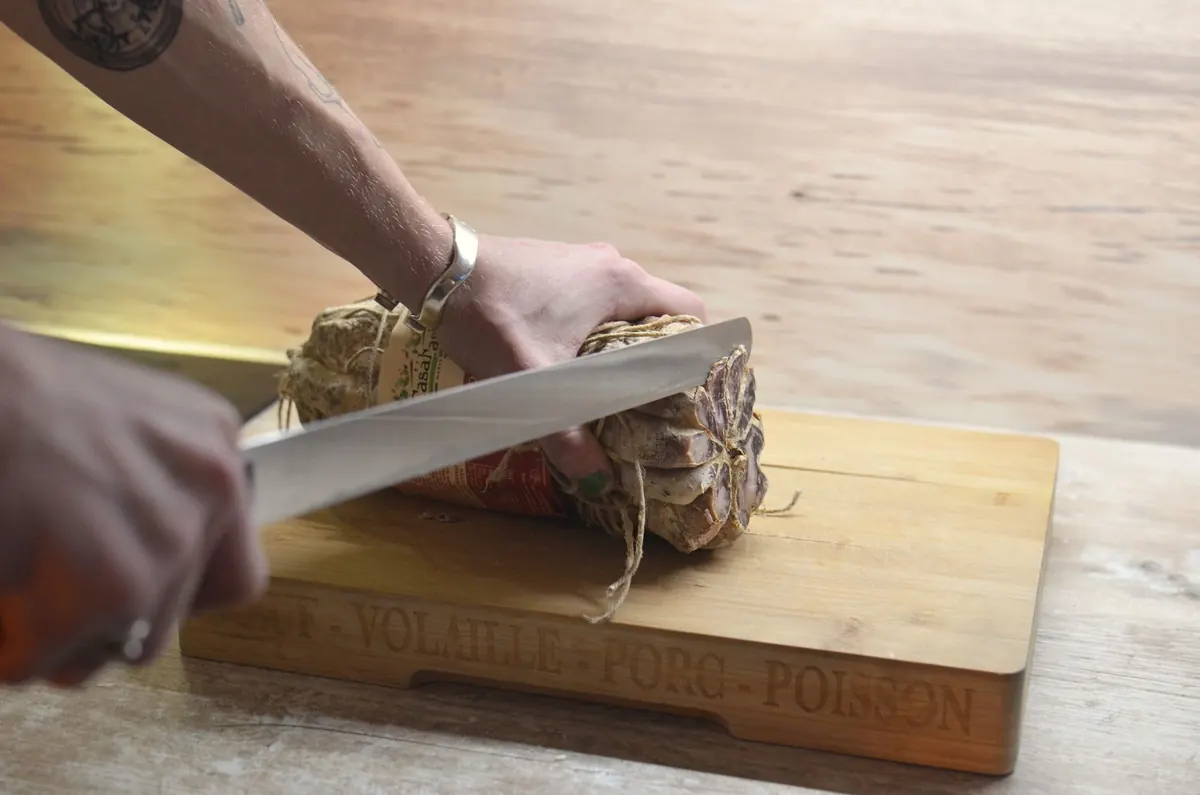
More flavor, better moisture, and a built-in bonus: when the meat is gone, that bone goes into a pot with dried beans, a chopped onion, and water for the best soup of the season. The trade-offs are weight and carving. You pay for the bone, and slicing around it takes a little patience and a long, thin knife. One reassuring note: the meat close to the bone sometimes looks darker or pinker than the rest. On a cured ham, that's the cure doing its work, not rawness. Confirm with your thermometer and serve with confidence.
Boneless
Effortless to carve, easy to slice thin for sandwiches, and it takes up less fridge space. Look closely at how it was made. Some boneless hams are a single muscle; others are pieces pressed together and sold in a net or casing. Single-muscle cuts hold their shape better on the platter. Boneless hams also tend to be water-added, so they can be softer and saltier than a bone-in roast.
Semi-Boneless
The hip bone is removed, the shank bone stays in. You get a flatter, more stable roast that's easier to slice than a full bone-in ham, with a little more structure than a boneless one. If you're nervous about carving in front of guests, this is a smart compromise.
Shank Half, Butt Half, and Spiral Cutting
Half hams are sold two ways. The butt half comes from the upper leg and is meatier per pound. The shank half tapers toward the ankle, carries proportionally more bone, and has a slightly richer, more marbled character. Neither is wrong. Buy the butt half if you want the most slices; buy the shank half if flavor matters more than yield.
Spiral-cut hams are pre-sliced in a spiral so every guest gets a neat piece without anyone wielding a knife. That convenience costs you moisture — all those cut surfaces dry out in the oven, and the slices fall apart into a pile. If you buy spiral-cut, glaze it and warm it gently, or serve it at room temperature. Don't roast it for two hours.
City Ham, Country Ham, and Fresh Ham
Almost everything in the refrigerated case is a city ham: wet-cured in brine, mild, moist, and ready to reheat. A country ham is dry-cured in salt and often aged — intensely salty, firm, and traditionally sliced paper-thin or soaked and simmered before cooking. It's wonderful, but it is not a beginner's Sunday roast. A fresh ham isn't cured at all; it's essentially a pork leg roast with a completely different flavor, and it must be fully cooked. Know which one you're holding before you plan the meal.
How Much Ham Do You Actually Need?
Use these as starting points, then round up:
- Bone-in: about 3/4 pound per person, because you're paying for bone and trimming some fat.
- Boneless: about 1/2 pound per person.
- Want leftovers? Add another 1/4 to 1/2 pound per person. Ham sandwiches and split pea soup are not a problem, they're the point.
- Heavy sides? Mashed potatoes, rolls, and a casserole all shrink appetites. A lighter plate of sides means more ham disappears.
So for ten people with leftovers in mind, an 8- to 10-pound bone-in half is a comfortable target; for eight people with no intention of cooking again until Wednesday, a 6- to 7-pound bone-in half works. A ham that's slightly too big is a planning success. A ham that's slightly too small is a dinner problem.
Buy for the plate, not for the package. The label tells you what's inside; the guest list tells you what to buy.
Cooking It Without Wrecking It
Because most hams are fully cooked, the goal is gentle heat. Set the oven to 325°F, put the ham fat-side up in a roasting pan, add a splash of water or stock, and cover it with foil. A rough guide is 15 minutes per pound, but the thermometer decides — pull it at 140°F. Save the glaze, whether it's brown sugar and mustard, maple and cider vinegar, or marmalade and cloves, for the last 20 to 30 minutes. Sugar applied early turns black and bitter. Let the roast rest 15 to 20 minutes before carving, or the juices will run out onto the board instead of staying in the meat. Refrigerate leftovers within two hours and use them within three or four days; sliced ham freezes well for a month or two.
The Aisle-Edge Decision
- Count your guests and decide whether leftovers are welcome. That gives you a weight.
- Choose bone-in for flavor and soup bones, semi-boneless for easier carving, boneless for sheer convenience.
- Pick up the package and read for "water added" and "fully cooked."
- Skip anything so heavy you can't lift it comfortably — a half ham usually beats a whole one for a home kitchen.
- Buy the thermometer if you don't own one. It's the cheapest insurance in the store.
That's the whole game. Once the size and the cut are right, ham is one of the most forgiving things you can serve: hard to overcook badly, easy to reheat, and generous with leftovers. Start with a bone-in half, glaze it late, and let the bone earn its keep in a pot of beans the next day.
Photo: Skylar Kang / Pexels